CBI 508 · Operations & Supply Chain Management
Find what actually limits your business before you spend to fix the wrong thing
In about seven weeks at nine hours a week, learn to measure any process, find its bottleneck, size the stock it needs and test every automation claim against your own volume.
For owners and managers who must commission, judge and fund changes to how the work gets done.
One-time paymentInstant access14-day money-back guarantee
Our students work at






What you'll learn
Everything you will learn in Operations & Supply Chain Management
38 topics, taught at graduate level and explained from first principles.
- 38 topics
- 55 hours of study
- 12-chapter textbook
- Graduate level
01Processes and flow
- Describe any business as a set of processes that turn inputs into what a customer receives
- Draw a process flow diagram with activities, buffers and flows
- Measure flow rate, flow time and inventory in one flow unit
- Apply Little's Law to find the quantity you cannot measure directly
- Tell flow time from touch time and compute flow efficiency
- Compute cycle time and takt time and compare the pace of the process with the pace of demand
02Capacity, bottlenecks and waiting
- Compute design and effective capacity for each step
- Find the bottleneck and the utilization of every other step
- Predict where the bottleneck moves after an improvement
- Choose a process type and layout for your volume and variety
- Compute waiting time and queue length with simple queueing formulas
- See how variability, utilization and pooling change waiting
- Set a service target and the spare capacity it requires
03Quality and lean
- Build and read a control chart
- Calculate Cp, Cpk and the defect rate
- Price the cost of quality: prevention, appraisal, internal and external failure
- Apply just-in-time, jidoka, pull and kanban
- Cut changeover time and quantify the capacity it frees
- Draw a value-stream map and find where the waiting is
04Inventory and planning
- Compute the economic order quantity and see why the optimum is flat
- Set safety stock and a reorder point for a service level
- Solve a single-buy decision with the newsvendor model
- Measure forecast bias, MAD, MAPE and the tracking signal
- Build a monthly sales-and-operations plan against capacity
- Quantify what product variety costs in stock and forecast error
- Decide which products to cut and which to keep
05Supply chain and logistics
- Measure the bullwhip effect and name its four causes
- Choose remedies: shared demand data, shorter lead times, vendor-managed inventory
- Compare direct and intermediated sourcing on total cost of ownership
- Compute landed cost and time by transport mode
- Price a resilience buffer and its break-even probability
- Estimate freight emissions with tonne-kilometers and emission factors
06Automation and the integrated decision
- Compute break-even volume, equivalent annual cost and payback
- Test a vendor's automation or AI claim against your own volume
- Know where automation fails: variety, ramp-up and a new bottleneck
- Judge digital twins and predictive maintenance as a manager, not an engineer
- Stage a capital commitment with triggers and review dates
- Present an operations recommendation with its assumptions, uncertainty and ethical limits
All 38 topics for $149. One-time payment, lifetime access.
Requirements
What you need to start
Very little. The course is built for people who have not studied this before.
- No experience required. The course starts from first principles.
- No engineering or operations background needed. Every term is explained the first time it appears.
- No paid software required. A free spreadsheet such as Google Sheets is enough.
- No planning software needed. Every calculation is done by hand on small data, so you understand what the software does.
- No programming knowledge needed.
- No advanced math. Arithmetic, percentages and a square root are all you use.
- No degree required. You do not need to have studied business before.
- A phone, tablet or computer. Any device with an internet connection.
- English. Every class has captions.
Is this for you?
Who this course is for
- Owners deciding whether to expand a facility or buy equipment
- Founders whose growth is outrunning their operations
- General managers who fund operational change
- Operations and plant managers who want the theory behind the practice
- Supply chain, purchasing and logistics managers
- Retail, e-commerce and subscription operators managing stock and fulfillment
- Restaurant, hospitality and service managers who run queues
- Product managers who promise delivery dates
- Finance staff who evaluate capital requests from operations
- Engineers and technical leads moving into management
- Consultants who advise on efficiency and capacity
- Buyers deciding between automation vendors
- Sustainability leads who must price emissions and resilience
- Nonprofit and healthcare administrators who manage flow and waiting
- Students preparing for graduate business study
- Career changers who want graduate-level operations training
Not for you ifyou want live lectures or a study group. Everything here is self-paced.
Look inside
See a class, a study card and the marking before you pay.
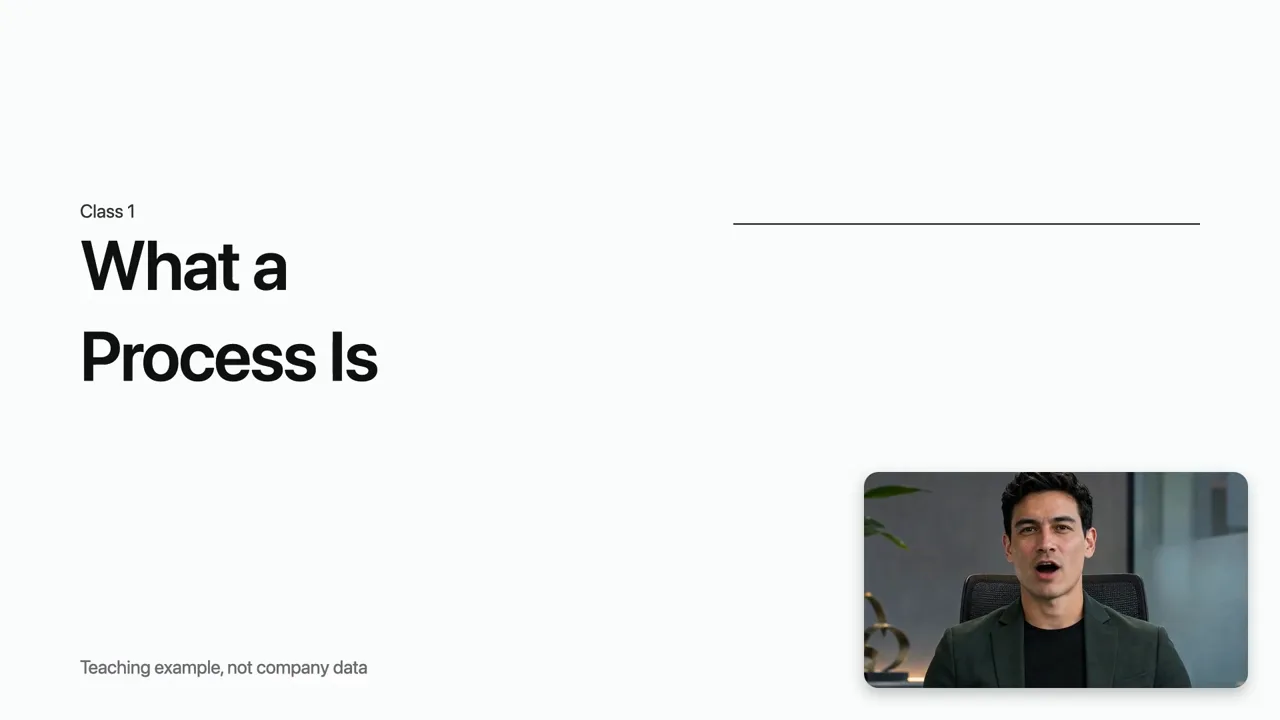
Watch the opening of class one, flip a real study card, and see exactly how your work is judged.
One of 48. Each returns just before you would forget it, so the course stays with you.
Case 2: Build, Buy or Wait? An Operations Recommendation for Target, Chewy or Five Below. You see the rubric before you start, and get written feedback on every criterion.
The full textbook and the study guide written to it, so you can look anything up after you finish.
The classes
Every class, in the order you will need it.
01What a Process IsDraw a process, name its flow unit, and use Little's Law to find flow rate, flow time or inventory from the other two
- Fast machines, slow coffee
- The big idea and the five parts
- What a process is
02Capacity, Bottlenecks, and Process DesignCompute the capacity and utilization of every step, find the bottleneck, and predict where it moves when you relieve it
- Where the limit sits
- A company average that hides two sites
- The big idea and the five parts
03Variability and WaitingCalculate waiting time and queue length at any utilization, and decide how much spare capacity a service target needs
- From the bottleneck to the queue
- A line with room to spare that still waits
- The big idea and the five parts
04Quality, Lean, and the Toyota Production SystemBuild a control chart, compute Cp and Cpk, price the cost of quality, and quantify the capacity a faster changeover frees
- From waiting to variation
- A bag that is nearly right
- The big idea and the five parts
05Inventory Under UncertaintySet an economic order quantity, safety stock and reorder point, and solve a single-buy decision with the newsvendor model
- From delay and variation to stock
- Two people, two bills
- The big idea and the five parts
06Forecasting, Complexity, and PlanningMeasure forecast bias and error, build a monthly plan against capacity, and price what product variety costs in stock
- From stock to the forecast behind it
- Every forecast too high, and only four percent off
- The big idea and the four parts
07Supply Chain Design and the Bullwhip EffectMeasure the bullwhip effect across a supply chain, name its cause, and choose the remedy and sourcing mix that fix it
- From one forecast to a whole chain
- Same consumers, wilder orders
- Pampers and the bullwhip
08Logistics, Resilience, and Sustainable FlowsCompute landed cost, time and emissions by route, and price a resilience buffer with its break-even probability
- From one chain to the goods that move
- Sea or air to the United Kingdom?
- The big idea and the five parts
09Automation, Robotics, and AI in OperationsCompute break-even volume and payback for automation and AI proposals, and test a vendor's claim against your own volume
- From priced slack to priced machines
- Three pitches in one week
- The big idea and the five parts
10Building the Third Site, Integrated Case, Ethics, and Individual AssessmentProduce a staged operations recommendation: which constraint to relieve first, what to defer, and the trigger for each
- Putting the whole course to work
- Three proposals on the owner's desk
- The big idea and the five parts
When you will see results
You will use it at work before you finish.
- After class 1
You measure any process with three numbers and use Little's Law to find the one you can't count directly
- After class 2
You find the bottleneck of a multi-step process and know which upgrade adds output and which one just adds stock
- After class 5
You set order quantities and safety stock for a service level, and can say what each unit of stock is buying
- After class 10
You present a staged recommendation on capacity, sourcing and automation, with its assumptions, triggers and risks stated.

Your time
Built to fit around a full-time job.
About 55 hours in total, at whatever pace your week allows. Nothing is live, the portal remembers exactly where you stopped, and study cards take about five minutes a day.
Two case assignments
Sweetgreen at the Lunch Peak: Where the Bowl Line Really Breaks
You analyze Sweetgreen from its public information and write a diagnosis of where its lunch-peak line really breaks. It is marked against this rubric, with written feedback on every criterion, usually within the hour. You finish with work you can show.
Each criterion is judged Exemplary, Proficient, Developing or Beginning.
Before you decide
You don't need an engineering background or planning software. Arithmetic and a spreadsheet are enough.
- Each class ends with a short quiz, so you know it stuck before you move on.
- Study cards bring back what you would forget, five minutes a day.
- The portal always shows your next step, so a busy week never becomes a lost month.
What $149 gets you
The complete course, for one price.
- Video classes you can fit around workPause anywhere and pick up on any device. Captions on every class, so you can study with the sound off.
- The full Operations & Supply Chain Management textbook, yours to keepPDF and EPUB, so you can look things up long after you finish.
- A study guide that covers every classThe key ideas, models and worked examples in one place, so you never write your own summary notes.
- 11 quizzes and exams, marked fastQuizzes are marked the moment you submit and exams usually within minutes, with the reasoning behind every answer, so you know what stuck and what to revisit.
- Two real-company cases with written feedbackStarting with Sweetgreen. You finish with analysis you can show, marked against a published rubric.
- 48 study cards that keep it freshFive minutes a day. Each card returns just before you would forget it.
- Your progress, saved everywhereThe portal remembers exactly where you stopped, so a busy week never sets you back.
- Lifetime access and updatesIt is there when the real decision arrives, including every future improvement to the course.
One payment. No subscription, no hidden fees.
What finding the real bottleneck is worth
If a $150,000 packing machine would add only 100,000 units a year because the next step becomes the limit, while cutting a changeover from 35 to 15 minutes adds 80,000 units for no capital, you get 80% of the gain for $0. Keeping that $150,000 in the business saves $12,000 a year in interest at 8%. The course costs $149, once.
One-time paymentInstant access14-day money-back guarantee
Questions
What people ask before they buy.
How much time will it take?
About 55 hours in total: the video classes, the readings, the quizzes and exams, and the case assignments. At nine hours a week that is about seven weeks. Nothing is scheduled, so you set the pace.
Is this right for beginners?
Yes. Class 1 starts by defining a process and its three numbers, and each class adds one idea to the last. You should be comfortable with percentages, averages and a standard deviation; a short preparation unit refreshes them. No operations or engineering background required.
What if I'm too busy?
Nothing is live and nothing expires. Each class stands on its own, the portal remembers exactly where you stopped, and your study cards take about five minutes a day. Pause for a month and pick up where you left off.
I've started online courses before and never finished. Why is this different?
It is built so you finish. Every class ends with a short quiz, study cards bring back what you would otherwise forget, and the portal always shows your next step. Two graded cases give you a reason to apply it, not just watch it.
When will I see results?
After class 1 you can measure a process and apply Little's Law. After class 2 you can find a bottleneck and judge an expansion, and after class 5 you can set inventory policy for any item.
Why is it worth $149?
You get the complete course: every video class, the full textbook and study guide, a quiz for each class, a final exam, and two real-company cases with written feedback. One capacity decision made on evidence can be worth far more than $149.
What if it isn't right for me?
If the course isn't right for you, ask within 14 days of buying for a full refund. It applies as long as you've watched fewer than three classes and haven't submitted an assignment.
How much math is involved?
Arithmetic, a square root and reading a z-table. You will use Little's Law, a queueing formula, EOQ and break-even volume, always on small worked examples first. A spreadsheet does the rest.
Does it cover automation and AI?
Yes. Class 9 computes the break-even volume and payback of a robotics proposal and tests a vendor's AI forecasting claim by what it changes in stock, and class 10 brings every tool together on one investment decision.
Is it only for factories?
No. The course follows one growing coffee roaster, but the same tools apply to services, warehouses, subscriptions and queues. Little's Law is applied to subscribers and waiting orders as well as to bags.
How do I get access?
Straight after checkout you are signed in to the CBI student portal and can start class one. We also email you a sign-in link so you can come back from any device.
CBI 508 · Operations & Supply Chain Management
Find what actually limits your business before you spend to fix the wrong thing
Start tonight. If it isn't right for you, ask within 14 days for a full refund.
One-time paymentInstant access14-day money-back guarantee
Our students work at