CBI 504 · Marketing Management
Know which marketing actually pays before you spend more
In about six weeks at nine hours a week, learn to choose the right customers, price on value and measure what your spend really returns.
For marketers and founders who spend on ads but can't say which channels bring customers.
or 4 interest-free payments of $37.25 with Klarna or Afterpay
Get Instant AccessOne-time paymentInstant accessLifetime access
Our students work at









Black Friday week at CBIIt’s Black Friday at CBIBlack Friday weekend at CBICyber Monday · Today only
Black FridayCyber Monday
Skip the gadgets. This Black Friday, invest in the one thing that compounds: what you know.
Twelve graduate-level business courses. Lifetime access. Start today, or in January.
Our lowest prices of the year. Applied automatically at checkout.
What you'll learn
Everything you will learn in Marketing Management
37 topics, taught at graduate level and explained from first principles.
- 37 topics
- 51 hours of study
- 11-chapter textbook
- Graduate level
01Customers and what they value
- Define customer value: perceived benefits minus perceived costs
- Write a value proposition you can test
- Map how consumers and business buyers decide
- Use the jobs-to-be-done method
- Run interviews, surveys and observation, and avoid biased answers
- Test ideas with A/B tests, holdouts and live offers
02Segmentation, targeting and positioning
- Segment consumer and business markets
- Test whether a segment is worth targeting
- Rank segments by value, not by size
- Write a positioning statement with a reason to believe
- Draw and read a perceptual map
- Know when and how to reposition
03Brand and product
- Understand what brand equity is and how to measure it
- Plan brand architecture and brand extensions without diluting the brand
- Design the whole offering: product, service, packaging and format
- Take a new product through development with stage-gates and concept tests
- Launch a minimum viable offering
- Predict how a new product spreads, and what speeds adoption
04Pricing
- Set a price from customer value, not from cost
- Calculate economic value to the customer
- Measure willingness to pay
- Build good, better and best tiers
- Work out the extra volume a discount needs to break even
- Raise prices and explain the change
05Channels and communication
- Choose between direct and indirect channels
- Work out channel margins and the true cost of selling direct
- Plan a go-to-market sequence and manage channel conflict
- Set communication objectives and a message strategy
- Balance brand building with sales activation
- Plan media with reach, frequency and CPM, and set the budget
06Digital marketing and measurement
- Use search, social, email and content marketing
- Work with creators and influencers, including contracts and disclosure
- Manage reviews, ratings and a social-media crisis
- Measure what advertising really adds with incrementality tests
- Calculate customer lifetime value, acquisition cost and payback
- Analyze retention and churn by cohort
- Write an integrated marketing plan linked to cash flow
All 37 topics for $149. One-time payment, lifetime access.
Requirements
What you need to start
Very little. The course is built for people who have not studied this before.
- No experience required. The course starts from first principles.
- No marketing background needed. Every term is explained the first time it appears.
- No paid software required. A free spreadsheet such as Google Sheets is enough.
- No programming knowledge needed.
- No ad budget needed. The methods work at any size of spend.
- No advanced math. Arithmetic and percentages are all you use.
- No degree required. You do not need to have studied business before.
- A phone, tablet or computer. Any device with an internet connection.
- English. Every class has captions.
Is this for you?
Who this course is for
- Founders who do their own marketing
- Small-business owners who spend on ads
- Marketers who want the full strategy, not only one channel
- Social media and content specialists moving up
- Performance marketers who want to prove real results
- Product managers who own positioning and pricing
- Brand managers and brand owners
- Sales leaders who work with marketing
- E-commerce and direct-to-consumer sellers
- Agency staff and freelancers who advise clients
- Engineers and technical founders new to marketing
- Nonprofit and public-sector communicators
- Creators building a business around an audience
- Students preparing for graduate business study
- Career changers who want graduate-level marketing
Not for you ifyou want live lectures or a study group. Everything here is self-paced.
Look inside
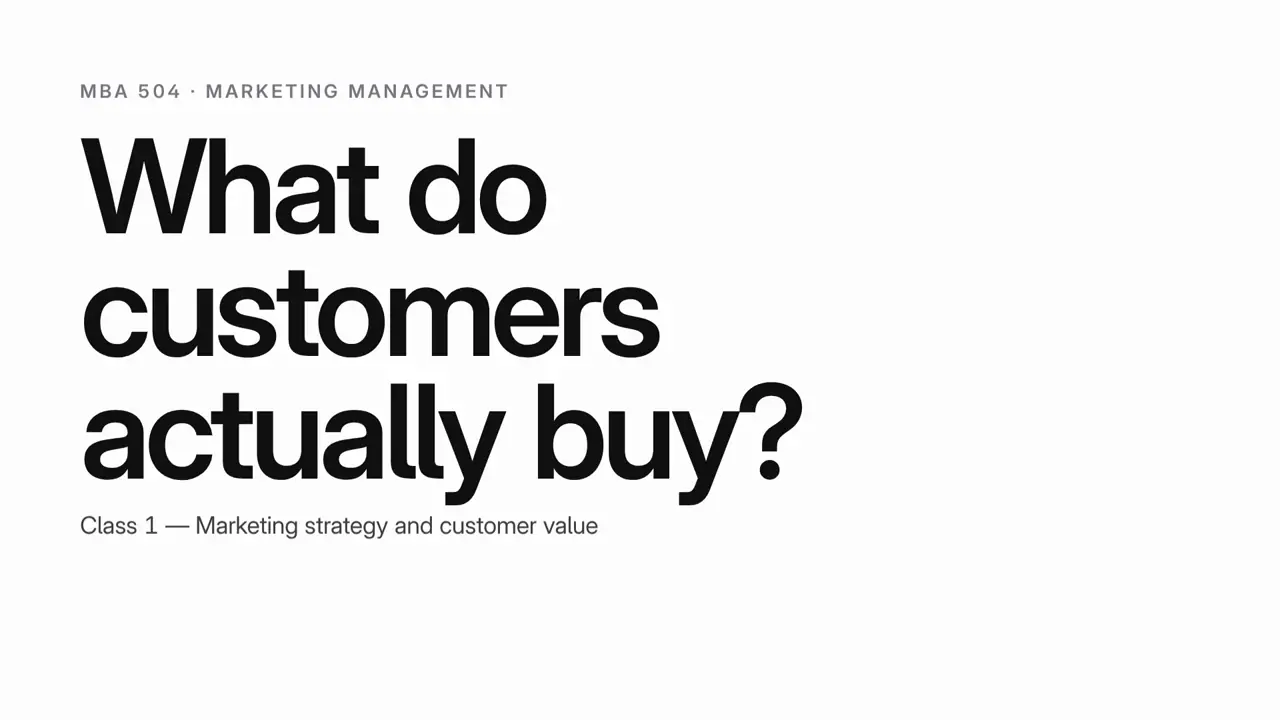
See a class, a study card and the marking before you pay.
Watch the opening of class one, flip a real study card, and see exactly how your work is judged.
One of 48. Each returns just before you would forget it, so the course stays with you.
Case 2: From Subscribers to Advocates. You see the rubric before you start, and get written feedback on every criterion.

The full textbook and the study guide written to it, so you can look anything up after you finish.
The classes
Every class, in the order you will need it.
01Marketing Strategy and Customer ValueWrite a testable value proposition naming target, benefit, and specific alternative.
- A machine that only pays for itself if someone buys
- A company whose customers paid more and came less
- One equation, four parts
02Customer Insight and Market ResearchIdentify which decision stage is broken. Run research efficiently: secondary data, interviews, surveys, then live tests.
- What the last class left unanswered
- A number that looked like the answer
- Why the wrong number is expensive
03Segmentation, Targeting, and PositioningDivide your market by behavior or benefit sought. Apply five segment tests. Rank groups by annual value, not size alone.
- Four names, and one decision still open
- A market is not everyone who might buy
- Why the choice is expensive either way
04Brand Strategy and Brand EquityMeasure what your brand name is worth in dollars. Run blind vs. branded tests. Calculate price premium from the gap.
- A market chosen; a name not yet earned
- What is our name worth to a customer?
- Why this isn't a design decision
05Designing and Developing the OfferingLayer your offering: core benefit, actual product, augmented services. Stage-gate with go/kill decisions at each phase.
- A name earned; a box still empty
- What exactly should we sell?
- Why the beans are the easy part
06Pricing for Customer ValueBuild pricing from EVC: P_alt + benefits − costs. Price below to leave surplus. Never use cost-plus in isolation.
- The box is full; there is still no number on it
- What is the right price, and who decides?
- Why cost-plus isn't wrong, just incomplete
07Channels and Go-to-MarketBuild a margin stack for each distribution route. Subtract channel-specific costs from net price. Compare fully costed NPVs.
- A price is set; now it needs a road to travel
- How should our coffee reach the people who want it?
- Direct, indirect, and the roads between
08Integrated Marketing CommunicationsState your communication objective: known, considered, chosen, or chosen again. Test with holdout. Budget by objective-and-task.
- A road is built; now it needs a signal
- How do we get noticed, and what is it worth?
- A simple path, and its real limits
09Customer Lifetime Value, Retention, and Marketing MetricsCompute customer lifetime value from margin, retention and discount rate, and track the metrics that matter.
- Forty dollars was the cost; today asks the value
- What is a customer worth?
- Four parts to today's plan
10Integrated Marketing Plan, Ethics, and Individual AssessmentPull every decision into an integrated marketing plan and defend it, including the ethical calls.
- A customer is worth what they keep bringing
- Can you defend the whole plan?
- What customers buy, and what research found

When you will see results
You will use it at work before you finish.
- After class 1
You can test a value proposition by writing three parts: target, unique benefit, named alternative. Fail any and rewrite.
- After class 3
You rank segments by annual value, not size, and know which ones to target first.
- After class 6
You price from the value customers get, not from your costs.
- After class 9
You can tell whether acquisition spending pays off, using customer lifetime value.

Your time
Built to fit around a full-time job.
About 51 hours in total, at whatever pace your week allows. Nothing is live, the portal remembers exactly where you stopped, and study cards take about five minutes a day.
Two case assignments
Spotify and the Unconverted ListenerA Strategic Marketing Memo
You analyze Spotify from its public information and write a strategic marketing memo on converting free listeners. It is marked against this rubric, with written feedback on every criterion, usually within the hour. You finish with work you can show.
- 01Customer Value, Research, and Evidence20%
- 02Segmentation, Targeting, and Positioning20%
- 03Brand Equity and Architecture15%
- 04Offering Design and Adoption15%
- 05Quantitative Analysis and Defended Recommendation20%
- 06Format, APA 7, and Integrity10%
Each criterion is judged Exemplary, Proficient, Developing or Beginning.
Before you decide
You don't need a big budget, a data team or a marketing degree. The tools work at any scale.
- Each class ends with a short quiz, so you know it stuck before you move on.
- Study cards bring back what you would forget, five minutes a day.
- The portal always shows your next step, so a busy week never becomes a lost month.
What $149 gets you
The complete course, for one price.
- Video classes you can fit around workPause anywhere and pick up on any device. Captions on every class, so you can study with the sound off.
- The full Marketing Management textbook, yours to keepPDF and EPUB, so you can look things up long after you finish.
- A study guide that covers every classThe key ideas, models and worked examples in one place, so you never write your own summary notes.
- 12 quizzes and exams, marked fastQuizzes are marked the moment you submit and exams usually within minutes, with the reasoning behind every answer, so you know what stuck and what to revisit.
- Two real-company cases with written feedbackStarting with Spotify. You finish with analysis you can show, marked against a published rubric.
- 48 study cards that keep it freshFive minutes a day. Each card returns just before you would forget it.
- Your progress, saved everywhereThe portal remembers exactly where you stopped, so a busy week never sets you back.
- Lifetime access and updatesIt is there when the real decision arrives, including every future improvement to the course.
One payment. No subscription, no hidden fees.
or 4 interest-free payments of $37.25 with Klarna or Afterpay
What one better budget decision is worth
If a holdout test shows one channel's sales are mostly organic and you move $2,000 a month to a channel that truly adds customers, that's $24,000 a year spent where it earns a return. The course costs $149, once.
One-time paymentInstant accessLifetime access
Questions
What people ask before they buy.
How much time will it take?
About 51 hours in total: the video classes, the readings, the quizzes and exams, and the case assignments. At nine hours a week that is about six weeks. Nothing is scheduled, so you set the pace.
Is this right for beginners?
Yes. It assumes no prior marketing experience. It starts from first principles: customer value (benefits minus costs), why stated intent differs from behavior, how to run tests. You need comfort with basic math and spreadsheets.
What if I'm too busy?
Nothing is live and nothing expires. Each class stands on its own, the portal remembers exactly where you stopped, and your study cards take about five minutes a day. Pause for a month and pick up where you left off.
I've started online courses before and never finished. Why is this different?
It is built so you finish. Every class ends with a short quiz, study cards bring back what you would otherwise forget, and the portal always shows your next step. Two graded cases give you a reason to apply it, not just watch it.
When will I see results?
After class 1 you can test a value proposition. After class 3 you can rank segments by value, after class 6 you can price from customer value, and after class 9 you can judge acquisition spend with lifetime value.
Why is it worth $149?
You get the complete course: every video class, the full textbook and study guide, marked quizzes and exams, and real-company cases with written feedback. One better budget decision can be worth far more than $149.
Do I need a big budget to use this?
No. Value propositions, segment tests, customer value pricing and simple holdout tests work as well on a $500 monthly budget as on a $5 million one.
Is this about social media tactics?
It covers the decisions behind the tactics: who to target, what to offer, what to charge, which channels to use and how to measure what worked. Search, social and owned media are covered in class 8 through that lens.
How do I get access?
Straight after checkout you are signed in to the CBI student portal and can start class one. We also email you a sign-in link so you can come back from any device.
CBI 504 · Marketing Management
Know which marketing actually pays before you spend more
Start tonight. Nothing is scheduled, and the portal keeps your place.
or 4 interest-free payments of $37.25 with Klarna or Afterpay
One-time paymentInstant accessLifetime access
Our students work at