CBI 509 · Information Systems, AI & Digital Transformation
Judge any technology or AI proposal before you pay for it
In about seven weeks at nine hours a week, learn to cost a systems decision over five years, judge an AI model by the cost of its mistakes and plan a digital roadmap in stages.
For owners and managers who approve technology and AI spending without a technical background.
One-time paymentInstant access14-day money-back guarantee
Our students work at










What you'll learn
Everything you will learn in Information Systems, AI & Digital Transformation
37 topics, taught at graduate level and explained from first principles.
- 37 topics
- 58 hours of study
- 13-chapter textbook
- Graduate level
01What an information system is and how the technology works
- See a system as people, process, data and technology, not just software
- Trace a process through its hand-offs and price the re-keying and errors
- Understand what a database does that a spreadsheet cannot
- Know what an API is and why it replaces re-keying
- Understand the cloud: infrastructure, platform and software as a service, and who is responsible for what
- Ask five questions of any technology proposal
02Choosing and implementing enterprise systems
- Understand ERP and CRM, and system of record versus system of engagement
- Tell configuring from customizing, and why customization is a hidden cost
- Build a five-year total cost of ownership, including the costs usually left out
- Compute the present value and net present value of a systems decision
- Score fit, time to value, control, vendor risk and exit
- Choose between big-bang, phased and pilot go-lives, and learn why implementations fail
03Data as an asset, and platforms
- Measure data quality on six dimensions, including duplicate and match rates
- Value data by the decisions it improves
- Assign a data owner and steward and write a one-page governance charter
- Decide who owns data created when customers use a product
- Tell a pipeline business from a platform and identify its network effects
- Compute take rate and dependence ratio, and stress-test a commission rise
04Machine learning and generative AI
- Understand supervised learning, features, labels, training and inference
- Spot overfitting and data leakage
- Read a confusion matrix and compute precision, recall, accuracy and lift
- Choose a threshold by the cost of each error, not accuracy
- Understand how a language model produces text and why it hallucinates
- Use retrieval to ground answers, and know what it still misses
- Compute cost per task from tokens and prices
05AI in the workflow and the business case
- Break a job into tasks and sort them into automate, augment or leave alone
- Tell human in the loop from human on the loop
- Build a business case with model, tool, oversight and error costs
- Compute payback and the break-even error rate
- Track quality metrics, not only volume, after launch
06Security, privacy, regulation and leading the change
- Compute annual expected loss and the value of a control
- Set recovery time and recovery point objectives, and question suppliers about backups
- Know what quantum computing does and does not threaten
- Apply the GDPR principles as a checklist for any new use of personal data
- Place AI uses in risk tiers and keep an AI-use-case register
- Test a hiring screen with the selection-rate ratio
- Build a staged three-year roadmap with gates, owners and value measures
All 37 topics for $149. One-time payment, lifetime access.
Requirements
What you need to start
Very little. The course is built for people who have not studied this before.
- No experience required. The course starts from first principles.
- No technical background needed. Every technical term is defined the first time it appears.
- No programming knowledge needed. Nothing is coded. You learn what the technology does, not how to write it.
- No paid software required. A free spreadsheet such as Google Sheets is enough.
- No advanced math. Percentages, a present-value factor and basic algebra are all you use.
- No degree required. You do not need to have studied business or computing before.
- A phone, tablet or computer. Any device with an internet connection.
- English. Every class has captions.
Is this for you?
Who this course is for
- Owners and founders being sold their first integrated system
- Managers asked to find a use for AI in their team
- Operations leaders who live with manual hand-offs and re-keying
- Finance leads who must approve technology budgets
- Marketing and e-commerce managers who depend on a platform or marketplace
- Customer-service leaders weighing an AI assistant
- HR leaders considering AI in hiring
- Product and project managers who work with engineers
- Consultants and advisers who recommend systems to clients
- Nontechnical board members and nonprofit trustees
- Engineers and technical leads moving into management
- Analysts moving into data or AI governance roles
- People expanding a business into a second country
- Students preparing for graduate business study
- Career changers who want graduate-level training in systems and AI
Not for you ifyou want live lectures or a study group. Everything here is self-paced.
Look inside
See a class, a study card and the marking before you pay.
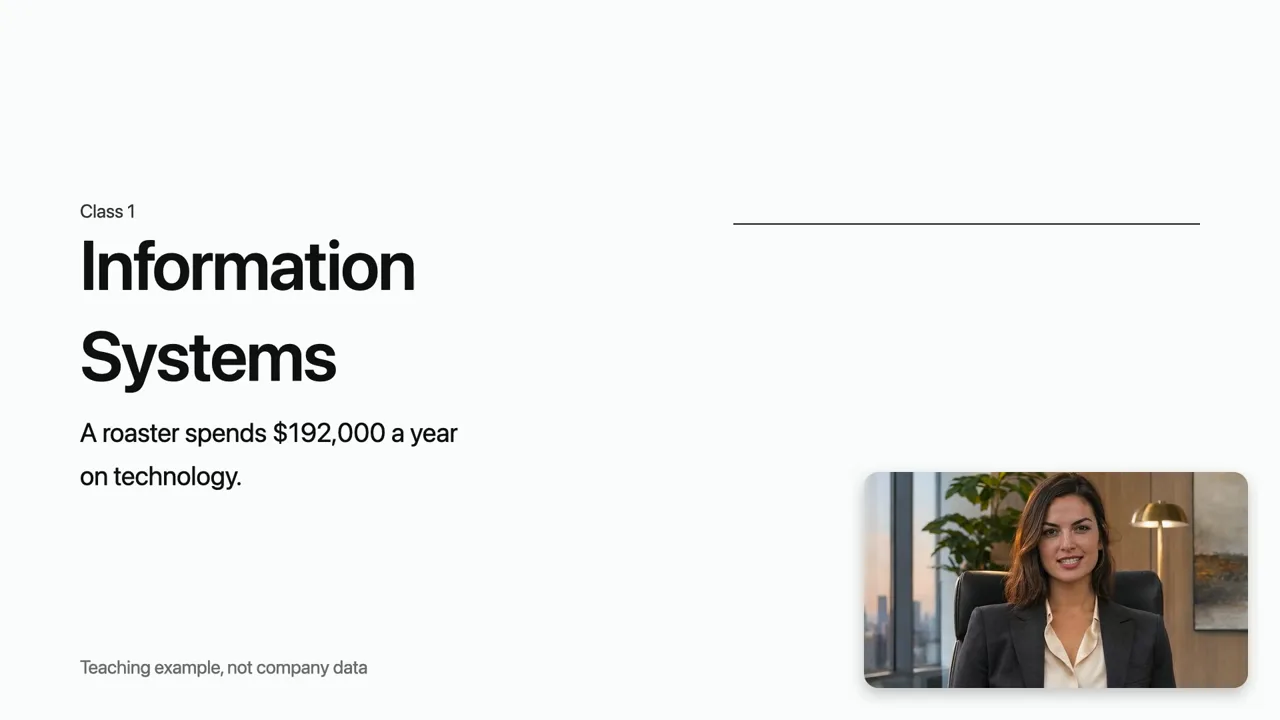
Watch the opening of class one, flip a real study card, and see exactly how your work is judged.
One of 48. Each returns just before you would forget it, so the course stays with you.
Case 2: Digital and AI Roadmap. You see the rubric before you start, and get written feedback on every criterion.
The full textbook and the study guide written to it, so you can look anything up after you finish.
The classes
Every class, in the order you will need it.
01Information Systems and How Technology WorksDefine an information system as people, process, data and technology; trace a process through its hand-offs and price the re-keying and errors
- The Question, and a Roaster to Ask It About
- The Big Idea and the Four Parts
- Data, Information, Knowledge, Decision
02Enterprise Systems and Build, Buy, or SubscribeCompare subscribe, buy and build by five-year cost and net present value, and see why enterprise systems fail at go-live
- The roaster's obvious answer
- What a rough start-up cost one company
- The big idea and the four parts
03Data as an Asset and How to Govern ItMeasure duplicate and match rates, value data by the decisions it improves, and write a data-governance charter
- Systems come and go; data stays
- One number, two answers
- The big idea and the road ahead
04Platforms and Network EffectsTell a pipeline from a platform; compute take rate and dependence ratio, and price what you lose if a platform changes its rules
- A bargain channel: six hundred thousand dollars through one marketplace
- The big idea and the four parts
- Pipeline or platform: two ways to earn from activity
05How Machine Learning WorksRead a confusion matrix; compute precision, recall, accuracy and lift, and choose a threshold by net value, not accuracy
- From platform rules to learning systems
- Ninety-one percent right, or ninety-six
- The base rate: how hard is the problem?
06Generative AI and Large Language ModelsExplain how a language model produces text and why it hallucinates; cost a task and read an error rate with its interval
- A proposal that looks obvious
- Plausible is not the same as checked
- Choosing a label versus writing text
07AI in the Workflow and the Business CaseSort tasks into automate, augment or leave alone, and build an AI business case with error cost, payback and break-even error rate
- Five months, or fifteen?
- One sentence to carry through the class
- A job is a bundle of tasks
08Security, Resilience, and the Quantum HorizonPrice an outage and a breach, value controls by expected loss, set a recovery target, and know what quantum computing does and does not threaten
- Eighteen thousand dollars looks sensible
- Assume failure: the big idea and the road ahead
- Three properties worth protecting
09Privacy, Regulation, and Responsible AIApply the GDPR principles and AI-regulation risk tiers, test a hiring screen with a selection-rate ratio, and draft an AI-use-case register
- The Roaster Plans a Launch, and Three Uses of Artificial Intelligence
- The Big Idea and the Four Parts
- What Counts as Personal Data
10Leading Digital Transformation, Integrated Case, Ethics, and Individual AssessmentBuild a three-year staged roadmap with costs, benefits and payback, and name the operating model, gates and value measures
- Nine ideas, one plan
- A plan that starts behind
- One sentence to hold on to
When you will see results
You will use it at work before you finish.
- After class 1
You map one real process, count its hand-offs and put a yearly cost on the re-keying and the errors, the first honest number in any technology case
- After class 2
You compare subscribe, buy and build by five-year cost and net present value, and know which assumption the decision hangs on
- After class 7
You build an AI business case that nets off errors and oversight, with payback and the break-even error rate, and can say whether to approve it
- After class 10
You present a three-year digital roadmap with staged funding, named owners and the measures that show whether it paid

Your time
Built to fit around a full-time job.
About 58 hours in total, at whatever pace your week allows. Nothing is live, the portal remembers exactly where you stopped, and study cards take about five minutes a day.
Two case assignments
Adobe's Renewal DeskA Systems, Data and Model Diagnostic
You analyze Adobe from its public information and write a systems, data and model diagnostic of its renewal desk. It is marked against this rubric, with written feedback on every criterion, usually within the hour. You finish with work you can show.
Each criterion is judged Exemplary, Proficient, Developing or Beginning.
Before you decide
You don't need a technical background or any programming. Every term is defined the first time it appears, and a spreadsheet does the arithmetic.
- Each class ends with a short quiz, so you know it stuck before you move on.
- Study cards bring back what you would forget, five minutes a day.
- The portal always shows your next step, so a busy week never becomes a lost month.
What $149 gets you
The complete course, for one price.
- Video classes you can fit around workPause anywhere and pick up on any device. Captions on every class, so you can study with the sound off.
- The full Information Systems, AI & Digital Transformation textbook, yours to keepPDF and EPUB, so you can look things up long after you finish.
- A study guide that covers every classThe key ideas, models and worked examples in one place, so you never write your own summary notes.
- 11 quizzes and exams, marked fastQuizzes are marked the moment you submit and exams usually within minutes, with the reasoning behind every answer, so you know what stuck and what to revisit.
- Two real-company cases with written feedbackStarting with Adobe. You finish with analysis you can show, marked against a published rubric.
- 48 study cards that keep it freshFive minutes a day. Each card returns just before you would forget it.
- Your progress, saved everywhereThe portal remembers exactly where you stopped, so a busy week never sets you back.
- Lifetime access and updatesIt is there when the real decision arrives, including every future improvement to the course.
One payment. No subscription, no hidden fees.
What one five-year comparison is worth
If a vendor proposes a licensed system at $410,000 up front and $108,000 a year, and a subscription does the same job for $110,000 up front and $84,000 a year, the five-year totals are $950,000 against $530,000. One comparison keeps $420,000 in the business. The course costs $149, once.
One-time paymentInstant access14-day money-back guarantee
Questions
What people ask before they buy.
How much time will it take?
About 58 hours in total: the video classes, the readings, the quizzes and exams, and the case assignments. At nine hours a week that is about seven weeks. Nothing is scheduled, so you set the pace.
Is this right for beginners?
Yes. The course assumes no technical background. Class 1 defines every technical term, from database to API to cloud, before it is used, and each later idea rests on the one before. You should be comfortable with percentages and a spreadsheet; a short preparation unit before class 1 covers the few statistics and present-value ideas the course uses.
What if I'm too busy?
Nothing is live and nothing expires. Each class stands on its own, the portal remembers exactly where you stopped, and your study cards take about five minutes a day. Pause for a month and pick up where you left off.
I've started online courses before and never finished. Why is this different?
It is built so you finish. Every class ends with a short quiz, study cards bring back what you would otherwise forget, and the portal always shows your next step. Two graded cases give you a reason to apply it, not just watch it.
When will I see results?
After class 1 you can price the hand-offs in a process. After class 2 you can compare subscribe, buy and build by net present value, and after class 5 you can read a confusion matrix and explain why a model that is 96% accurate can still be useless.
Why is it worth $149?
You get the complete course: every video class, the full textbook and study guide, a quiz for each class, a final exam, and two real-company cases with written feedback. One technology decision made with the right numbers can be worth far more than $149.
What if it isn't right for me?
If the course isn't right for you, ask within 14 days of buying for a full refund. It applies as long as you've watched fewer than three classes and haven't submitted an assignment.
Do I need to know how to code?
No. Nothing is programmed. You learn what software, databases, APIs, the cloud and machine-learning models do, at the level a manager needs to question a supplier or an engineer, and every calculation is done in a spreadsheet.
Will this go out of date?
The course teaches durable principles and decision methods. Products, prices and laws appear only as dated examples and are labeled as such, so what you learn still applies when the tools change.
Does it cover security and privacy law?
Yes. Class 8 prices an outage and a breach and values the controls, with a labeled section on what quantum computing does and does not threaten. Class 9 covers the GDPR principles, the EU AI Act's risk tiers and a fairness check for AI in hiring, all at framework level.
How do I get access?
Straight after checkout you are signed in to the CBI student portal and can start class one. We also email you a sign-in link so you can come back from any device.
CBI 509 · Information Systems, AI & Digital Transformation
Judge any technology or AI proposal before you pay for it
Start tonight. If it isn't right for you, ask within 14 days for a full refund.
One-time paymentInstant access14-day money-back guarantee
Our students work at