CBI 507 · Financial Accounting & Reporting
Read any company's accounts the way an investor does
In about seven weeks at nine hours a week, learn to read the income statement, balance sheet and cash-flow statement as one story, spot the estimates that move profit, and say what you would check before you trust the numbers.
For founders and managers who sign off accounts, borrow against them, or read someone else's before they invest.
One-time paymentInstant access14-day money-back guarantee
Our students work at









What you'll learn
Everything you will learn in Financial Accounting & Reporting
37 topics, taught at graduate level and explained from first principles.
- 37 topics
- 56 hours of study
- 12-chapter textbook
- Graduate level
01From transactions to statements
- Record transactions with the accounting equation and double entry
- Tell profit from cash and apply the accrual basis
- Make the four adjustments: accruals, prepayments, deferred revenue and depreciation
- Build an income statement, balance sheet and cash-flow statement from a trial balance
- Reconcile net income to cash from operations with the indirect method
- Compute free cash flow and know what it leaves out
02Revenue, inventory and cost of sales
- Apply the five-step revenue model to any customer contract
- Allocate a bundled price and estimate rebates and returns
- Recognize revenue over time and compute a catch-up when the estimate changes
- Tell a contract asset from deferred revenue and a receivable
- Compute cost of goods sold under FIFO, weighted average and LIFO
- Test inventory for write-down and compute inventory days
03Assets, leases and intangibles
- Decide whether spending is an asset or an expense
- Depreciate by straight line, declining balance and units of production
- Test an asset for impairment under IFRS and US GAAP
- Measure a lease liability and its first-year expense
- Decide when development costs are capitalized
- See how each choice changes profit, EBITDA and ratios without changing cash
04Liabilities, equity and groups
- Classify liabilities as current or non-current
- Book and roll forward a provision
- Tell a provision from a contingent liability
- Measure liquidity, net debt and covenant headroom
- Show how a share issue and a share sale change the balance sheet
- Compute goodwill and understand consolidation and the equity method
- Read a segment note to find where a group's profit is made
05Ratios, earnings quality and sustainability reporting
- Compute margins, returns and the DuPont breakdown
- Measure the cash conversion cycle
- Test earnings quality with cash conversion and the accruals ratio
- Build an adjusted EBITDA bridge with a reason for every item
- Judge a company's non-GAAP measures
- Read greenhouse gas scopes, intensity and double materiality disclosures
06Audit, control and the investor's reading
- Read an audit opinion and know what it does not promise
- Rank audit evidence by reliability and set materiality
- Design controls for a payment process and spot fraud red flags
- Contrast US GAAP and IFRS on the same transaction
- Judge where AI and data tools help the close and the audit, and where they mislead
- Write a data-room request list and a one-page investor conclusion
All 37 topics for $149. One-time payment, lifetime access.
Requirements
What you need to start
Very little. The course is built for people who have not studied this before.
- No experience required. The course starts from the accounting equation.
- No accounting background needed. Every term is defined in plain words before it is used.
- No paid software required. A free spreadsheet such as Google Sheets is enough.
- No bookkeeping software needed. You work small examples by hand so you know what the software does.
- No programming knowledge needed.
- No advanced math. Percentages, ratios and basic algebra are all you use.
- No degree required. You do not need to have studied business before.
- A phone, tablet or computer. Any device with an internet connection.
- English. Every class has captions.
Is this for you?
Who this course is for
- Founders who show their accounts to a bank or an investor
- Owners who want to understand their own year-end statements
- Managers who receive a monthly finance pack and want to question it
- People buying, selling or investing in a business
- Startup employees reading their company's financials for the first time
- Engineers and technical leads moving into general management
- Product and operations managers who work with the finance team
- Sales leaders whose contracts decide when revenue is recognized
- Board members, nonprofit trustees and audit committee members
- Lenders and credit analysts early in their careers
- Consultants and advisers who read clients' accounts
- Individual investors who want to read an annual report properly
- Bookkeepers moving into financial reporting
- Students preparing for graduate business study
- Career changers who want graduate-level accounting
Not for you ifyou want live lectures or a study group. Everything here is self-paced.
Look inside
See a class, a study card and the marking before you pay.
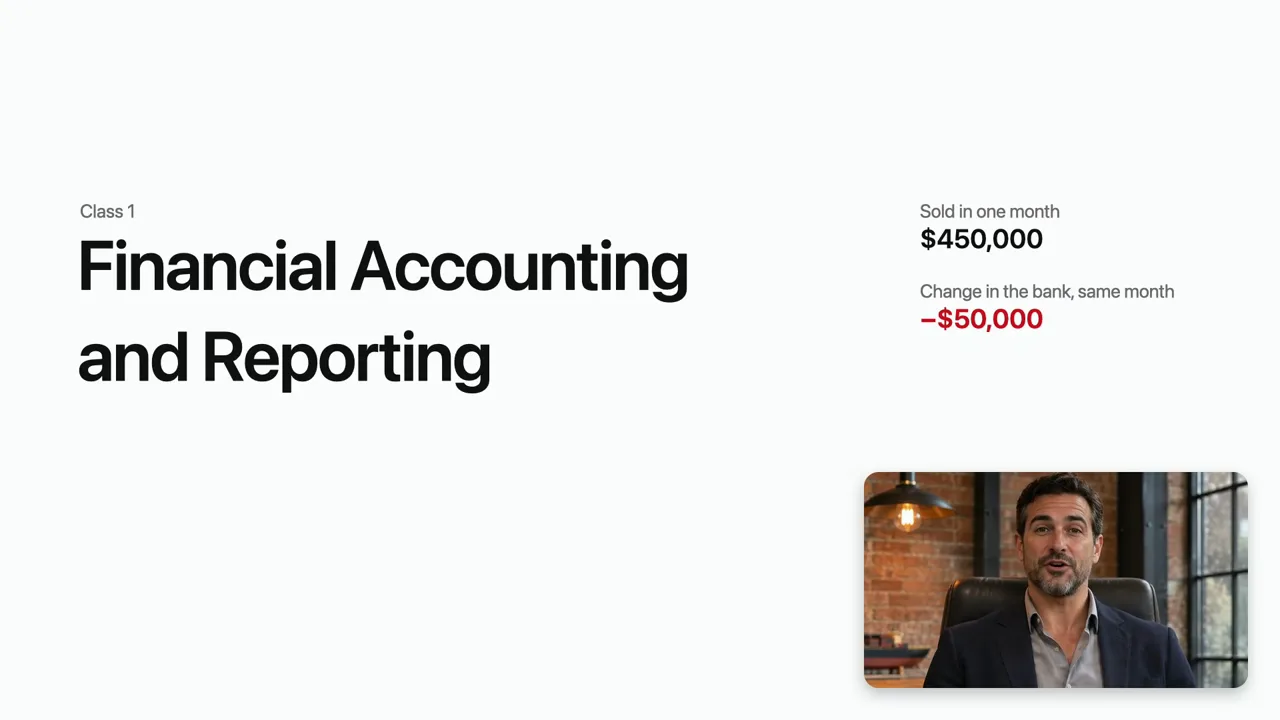
Watch the opening of class one, flip a real study card, and see exactly how your work is judged.
One of 48. Each returns just before you would forget it, so the course stays with you.
Case 2: The Investor's Reading. You see the rubric before you start, and get written feedback on every criterion.
The full textbook and the study guide written to it, so you can look anything up after you finish.
The classes
Every class, in the order you will need it.
01The Accounting Equation, Double Entry, and AccrualRecord a month of transactions with double entry, make the four accrual adjustments and show in numbers why a profitable month can drain cash
- One month, five events, one puzzle
- The big idea and the five parts
- Six readers who cannot see inside
02The Three Financial StatementsBuild the income statement, balance sheet and cash-flow statement as one connected set, and bridge net income to cash from operations
- From profit to a full set of reports
- A profit and a fall in cash
- One photograph and two films
03Revenue RecognitionApply the five-step revenue model to bundles, rebates, agent sales and long contracts, and compute a catch-up when an estimate changes
- From three statements to the first line
- Three customers, three moments of payment
- What it means to recognise revenue
04Inventory and Cost of SalesCompute cost of goods sold under FIFO, weighted average and LIFO, test inventory for write-down and price the cash tied up in stock
- From revenue to the cost behind it
- Forty thousand dollars of coffee nobody wants
- Why one line moves a large number
05Long-Lived Assets, Leases, and Development CostsDepreciate an asset three ways, test it for impairment, measure a lease liability and decide when development spending is an asset
- From stock to long-lived assets
- Thirty thousand dollars, two profits
- Spread the cost, then test the benefit
06Liabilities, Provisions, and EquityClassify liabilities, roll a provision forward, measure covenant headroom and show how a share issue changes the balance sheet
- From assets to claims
- A profitable roaster that breaks a promise
- The big idea and the four parts
07Groups, Segments, and Sustainability ReportingCompute goodwill, read a segment table to find where the profit is made, and judge what a sustainability report should disclose
- From one company's claims to a family of companies
- A million dollars for seven hundred thousand
- The big idea and the four parts
08Ratios and Quality of EarningsRun a full ratio set with the DuPont breakdown, test cash conversion and build an adjusted EBITDA bridge you can defend
- From where profit comes to what it is worth
- A profit that looks excellent
- What a ratio is, and three yardsticks
09Audit, Control, and Accounting StandardsPrepare a bank reconciliation, rank audit evidence, set materiality, design three controls and contrast US GAAP with IFRS on one transaction
- From the worth of a profit to the worth of a number
- Four hundred twenty thousand, or four hundred forty-seven?
- The big idea and the five parts
10The Investor's Reading of the Roaster, Integrated Case, Ethics, and Individual AssessmentRead a full set of statements as an investor: connect them, adjust them, test leverage, list what to verify and write a one-page conclusion
- From evidence to a reading
- Everything on the front page looks fine
- The big idea and the five parts
When you will see results
You will use it at work before you finish.
- After class 1
You record a month of transactions, keep the accounting equation in balance and show in numbers why a profitable month can leave less cash in the bank
- After class 2
You reconcile net income to cash from operations and explain a year in which the business made a profit and its cash fell
- After class 6
You can say whether a business can meet its claims: its liquidity, its leverage and the headroom left under a loan covenant
- After class 10
You read a full set of accounts as an investor, build an adjusted EBITDA you can defend, and list what you would verify before you rely on the numbers

Your time
Built to fit around a full-time job.
About 56 hours in total, at whatever pace your week allows. Nothing is live, the portal remembers exactly where you stopped, and study cards take about five minutes a day.
Two case assignments
Crocs, Inc.What the Reported Profit Is Worth
You analyze Crocs from its public information and write a memo on what its reported profit is really worth. It is marked against this rubric, with written feedback on every criterion, usually within the hour. You finish with work you can show.
Each criterion is judged Exemplary, Proficient, Developing or Beginning.
Before you decide
You don't need an accounting background or any bookkeeping software. Arithmetic and a spreadsheet are enough.
- Each class ends with a short quiz, so you know it stuck before you move on.
- Study cards bring back what you would forget, five minutes a day.
- The portal always shows your next step, so a busy week never becomes a lost month.
What $149 gets you
The complete course, for one price.
- Video classes you can fit around workPause anywhere and pick up on any device. Captions on every class, so you can study with the sound off.
- The full Financial Accounting & Reporting textbook, yours to keepPDF and EPUB, so you can look things up long after you finish.
- A study guide that covers every classThe key ideas, models and worked examples in one place, so you never write your own summary notes.
- 11 quizzes and exams, marked fastQuizzes are marked the moment you submit and exams usually within minutes, with the reasoning behind every answer, so you know what stuck and what to revisit.
- Two real-company cases with written feedbackStarting with Crocs. You finish with analysis you can show, marked against a published rubric.
- 48 study cards that keep it freshFive minutes a day. Each card returns just before you would forget it.
- Your progress, saved everywhereThe portal remembers exactly where you stopped, so a busy week never sets you back.
- Lifetime access and updatesIt is there when the real decision arrives, including every future improvement to the course.
One payment. No subscription, no hidden fees.
What one careful reading of your own accounts is worth
If reading your statements shows customers take 60 days to pay against 30-day terms, and you bring that back to 45, a business with $3,000,000 of annual sales frees about $123,000 of cash: $3,000,000 divided by 365, times 15 days. The course costs $149, once.
One-time paymentInstant access14-day money-back guarantee
Questions
What people ask before they buy.
How much time will it take?
About 56 hours in total: the video classes, the readings, the quizzes and exams, and the case assignments. At nine hours a week that is about seven weeks. Nothing is scheduled, so you set the pace.
Is this right for beginners?
Yes. The course starts with the accounting equation and double entry and builds one idea on the last. No prior study of accounting is assumed. If you can compute a percentage and read a table with a total row, you are ready.
What if I'm too busy?
Nothing is live and nothing expires. Each class stands on its own, the portal remembers exactly where you stopped, and your study cards take about five minutes a day. Pause for a month and pick up where you left off.
I've started online courses before and never finished. Why is this different?
It is built so you finish. Every class ends with a short quiz, study cards bring back what you would otherwise forget, and the portal always shows your next step. Two graded cases give you a reason to apply it, not just watch it.
When will I see results?
After class 1 you can show in numbers why profit and cash differ. After class 2 you can reconcile net income to cash from operations, and after class 6 you can test whether a business can meet its claims and stay inside its loan covenants.
Why is it worth $149?
You get the complete course: every video class, the full textbook and study guide, a quiz for each class, a final exam, and two real-company cases with written feedback. One avoided misreading of a set of accounts can be worth far more than $149.
What if it isn't right for me?
If the course isn't right for you, ask within 14 days of buying for a full refund. It applies as long as you've watched fewer than three classes and haven't submitted an assignment.
Does it cover both US GAAP and IFRS?
Yes. Every rule that differs is labeled, and the differences are shown on the same company's numbers: LIFO, development costs, impairment reversals, lease expense and provisions.
Is this bookkeeping or analysis?
Both, in that order. You record transactions by hand in the first two classes so you know what the software does, then spend the rest of the course reading, testing and questioning statements the way an outside investor does.
Does it cover sustainability reporting?
Yes. Class 7 covers greenhouse gas scopes, intensity measures, double materiality and the main reporting frameworks, and how those disclosures connect to the financial statements.
How do I get access?
Straight after checkout you are signed in to the CBI student portal and can start class one. We also email you a sign-in link so you can come back from any device.
CBI 507 · Financial Accounting & Reporting
Read any company's accounts the way an investor does
Start tonight. If it isn't right for you, ask within 14 days for a full refund.
One-time paymentInstant access14-day money-back guarantee
Our students work at